Showing posts with label Historical. Show all posts

Friday, February 28, 2020

Guadalupe Mountains National Park


Our next park up was Guadalupe Mountains in the Northwestern area of Texas, on the boarder with New Mexico. This park has both a lot of opportunities to hike and a lot of history, and we got the opportunity to explore both. 

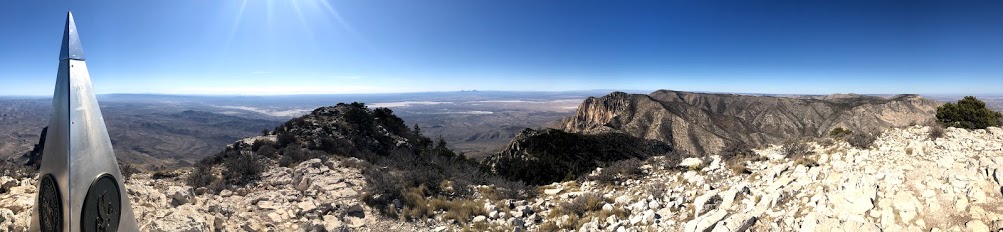
On Thursday we started by doing some of the hiking. There were a ton of good hiking option but we settled on climbing up to see the highest point in Texas. We almost turned back because we were feeling a little under the weather but we're so glad we didn't. The 3,000 feet of elevation gain over 4.2 miles up the mountain were definitely strenuous. The trail was a little bit scary at times. 


The view was worth fighting through the slight illness and fear. 


Unfortunately Kathleen's shoes have decided they've had about enough of hiking. 


On Friday, we explored the historic aspects of the park. We started with the Frijole Ranch Historical Museum. The museum is housed in an old ranch house that was built by some of the first white settlers in the area who came to ranch cattle. The house was later expanded by the Smith family who came and built an orchard. They also added a school house which doubled as a post office and community gathering area. 


Inside the house they also have information about the Mescalero Apache who lived in the area and placed great significance on the mountains, including in their origin story. Nearby parts of the park also served the Butterfield stage coach in 1858. The stagecoach was the first constant form of overland communication linking St. Louis and San Fransisco in 1858 and only ran for 11 months before a safer route opened up to the south.

After learning some of the history we took a short walk up to Smith Spring up the hill. 


We ended our exploration of the park up at McKittrick Canyon, which has been said to be the must beautiful spot in Texas. It was getting late in the day and we were pretty tired so we didn't do the full hike unto the canyon. Instead we contented ourselves with a shorter four mile out and back up the trail to just get a taste of it. 


There is definitely a lot to see in this park as there were tons more hikes that we didn't do. We both thought that coming back to do a backcountry backpacking trip would be a lot of fun, unfortunately since Aiden isn't allowed on most national park trails, now wasn't the time. But we felt like we saw a good amount of the park, and would love to come back in the future. 


Sunday, February 23, 2020

Big Bend National Park: Ross Maxwell Scenic Drive


Official NPS Map. Click and zoom in to enlarge for details.

For our third and final day in the park we decided to take on the Ross Maxwell Scenic Drive. The drive is 30 miles total down to the Santa Elena Canyon, and there are a plethora of stops and hikes to check out along the way. Because one of the highlights of the park for some people is the Santa Elena Canyon, we decided to start by driving the whole length of the road and then stop on our way back up.


The Santa Elena canyon hike (red arrow on map) is fairly short but it a little tough, you start by finding your way across a river and then going up and over a rocky pass into the canyon. It is gorgeous though!


The high walls of the Canyon can really make you feel small. 


Next we stopped at Dorgan House Trail (orange arrow on map), there was really hardly a hike here at all, mostly a walk out to the remnants of some old farm houses. We wanted to stop here because the ranger at the talk we attended in the Chisos Basin told us about the petrified wood fireplace. It was as cool as we hoped. 


Next up was the Castolon Visitor Center (yellow arrow on map). There used to be a historic town in Castalon, however it burnt down in 2019 so they are currently operating out of a temporary structure. There wasn't a lot to see here, so we got our final stamp for the park and moved on.


The trail that we decided we were both the most excited about was the Chimneys Trails (green arrow on map). The trail connects 7 miles through the desert over to a non-paved road. However, the Chimneys themselves are 2.4 miles out and can the hike can be done as an out and back. The trail is relatively flat, but completely in direct sun light and seems like it would be brutal in the summer. 


The Chimneys are very interesting rock structures sticking out of the desert. They were formed by magma seeping into cracks in other rock that has no eroded away, leaving only the mold of the cracks. 


The reason we picked this hike though was the ancient Native American art at the base of the rocks. 


The trail is also just a nice walk through the desert with great views of local flora and fauna.


After this hike we were pretty much ready to be done for the day. We stopped at the Lower Burro Mesa Pouroff trail (blue arrow on map) because it was short 1 mile out and back to get to the bottom of dry waterfall.


There is also a Upper Burro Mesa Pouroff trail that will get you to the top of the pouroff and looked very interesting. However that trail was longer, and we were starting to run out of time in the day. It is definitely on our list if we ever come back.

We made one last stop at the Sotol Vista (purple arrow) which looks out across the whole desert. It was lovely at dusk. Several people were setting up to watch the sunset, which promised to be beautiful, but we decided we wanted to keep moving and try to find our pullout before it got dark.


Overall it was a great day and a great way to finish up our time at Big Bend. We had big hopes for Big Bend and it didn't disappoint.


Friday, February 14, 2020

Hot Springs National Park


Hot Springs was yet another national park where we had absolutely no idea what to expect, which always makes for a nice treat. Until the Gateway Arch in St. Louis became a national park in February of 2018, Hot Springs was the smallest of the national parks. It has a long history and is the oldest "entity" in the system, having become a "Reservation" in 1832.  Part of becoming a reservation was the agreement that they would always offer free water to the public, so there are fountains all over offering fresh, warm spring water.


The national park is formed around a collection of upwellings of a natural hot spring. The water comes to the surface with an average temperature of 143ยบ F. People have been coming to the hot springs for bathing and rituals for as long as there have been people in the area. The Dunbar-Hunter Expedition "discovered" the hot springs for the United states in 1804 while they were exploring the new Louisiana purchase. Almost immediately a small town popped up as people flocked in to bath in the springs for the health benefits.

Over time, the springs became more accessible with the introduction of trains and then roads and the community and the baths became more sophisticated. The wooden structures on bath house row were slowly replaced by fancy stone bath houses with all of the possible amenities, two of which are still open for baths.

The current visitor center is in the fanciest of the old baths, which has been turned into a museum. The baths were very ornate and had fancy stained glass, like this piece on the ceiling of the men's changing rooms:


They also included "state of the art medical interventions."

These cabinets were for alternating between a heated sauna sit, on the right,
and a cold ice block sit, on the left. 
You would sit down in the contraption
with your head sticking out the hole on the top. 
Patients would stand in the needle shower on the wall, while a technician
would shoot them with high pressure water streams in a form of hydromassage. 
There have a "needle bath" that shoot water at you from the side to rinse all of the sweat and minerals off after a soak. 
A "Site bath." A small tube to sit in while mercury was applied to cure your syphilis. 
In the upper levels there was a gym that included early physical therapy machines, large lounges for spending the afternoon, a beauty parlors for hair and nails, and rooms for massages. In the peak of the popularity of the baths, in the late 1800s, rich people would come from around the country to stay in hot springs taking baths prescribed to them by a doctor every day for an average of 21 days.


There are still a few bathhouses that you can bathe in. Every package includes a bath in the natural spring water and needle shower and many include a steam room and massages as well. These were all a bit out of our price point. We did consider it though, it being Valentine's Day.

After touring the museum we took a hike on some of the paths in the hilly area included in the park. There was a nice walk up to the top where there was a lookout tower, but we elected not to pay to go up the tower. The view was already nice.


All in all, there isn't much to "see" at this National Park, but the history is interesting.

Wednesday, January 22, 2020

Travel Update 16


We just spent a wonderful week in the Dominican Republic visiting Kathleen's cousin Anna. It was short for an international trip but we did pack a lot in.

In Atlanta we dropped the kids off with a sitter and then headed to the airport. Since we weren't sure how long that would take we ended up at the airport pretty early and just walked around. While we were wandering a stranger offered us some pizza saying that they had bought too much. Given that we could figure out how he could have a motive to hurt us and we were inside airport security we decided it was probably safe to eat. Free dinner!


We flew in to the capital, Santo Domingo, and arrived fairly late. Luckily we had Anna to come pick us up at the airport, meeting us with fresh empanadas and fruit juice! After resolving an issue with the Uber that had been towed for illegally parking in a place Anna told him not to park, we headed into the capital to a fun hostel, called "Island Life", where we spent the first night.


We explored the hostel a little bit in the morning and it was quite cute. There was a central courtyard where breakfast was served that even included a small pool. They also had several hostel dogs. If we had been staying in Santo Domingo it definitely would have been a fun place to spend a couple of nights.


However, we didn't have very much time in Santo Domingo so we checked out fairly early and went to go walk through the historic district before catching our bus to the north. There is a lot of history in Santo Domingo, because it was the capital of the first Spanish Colony in the New World. As a matter of fact it was founded in 1496 by Bartholomew Columbus, Christopher Columbus's brother. There were lots of beautiful old churches and we also visited the first hospital in the New World.


Then we hopped on an Uber over to the bus stop where we caught the but to Sabana De La Mar in the northern part of the country. The view out of the bus was gorgeous, but the bus was comfortable enough to catch a few Z's since we hadn't gotten a lot sleep the night before.


When we got up to Sabana De La Mar we got a ride on a motor cycle out to our hotel on the outskirts of town. Then we walked back through town to meet a man name Halle for dinner. Halle was our designated tour guide for our adventures the next day in Los Haitises National Park. He was also with the company that had booked us our whale watching tour, so he was able to help us figure out the plans for the next couple of days. He was really friendly and we had a lot of fun with him, both at dinner over the course of the next day. And Sabana De La Mar was a cute little town that we had fun spending some time in.

Central Park in Sabana De La Mar
Hotel where we stayed while in Sabana De La Mar
Restaurant where we met Halle for dinner. 


After those two excited days in the north we had a travel day in which we took the same bus back down to the capital and then another huge bus down to Anna's region of Barahona. The long bus rides stop somewhere in the middle of the route to allow people to go to the bathroom and buy some food. The route down to Barahona stopped at an absolutely massive rest area that seemed like the dominican Buc-ee's, with much less branding.


Except the "express" busses, all of the buses will pick you up and drop you off anywhere along their route. So when the bus passed through Bombita we hopped off. We spent the next three day in Bombita getting to see how Anna lives her life.

On Wednesday morning Anna put us back on the early bus back to Santo Domingo. We managed to make it from the bus to a taxi and get to airport all by ourselves even with our limited Spanish. We were going to try to use Uber, which wouldn't have required any Spanish, but we got talked into getting driven by a taxi who wanted to take us for less money.

The DR is not without its share of issues, most of which can still be traced back to colonial days. Although the majority of the population has darker skin, people running for government positions almost always have lighter skin and will intentionally make themselves look whiter. The DR is also better off that its island neighbor Haiti. There were several of checkpoints on the way back from Anna's village to the capital where security officers are looking for "illegal immigrants". We were told that this generally plays itself out as them asking people who "look Haitian" (darker skin) to provide identification, and this was in fact how it played out in front of us. Of course, it didn't affect us personally, but it is something to be aware of when traveling there.

Overall we did have an amazing week in the Dominican Republic! To Kathleen it felt like where Guinea could be with about 20 more years of development, and the comparison drawing was constant. It also made her want to get back in the Global Health direction so that she can live abroad again. Andreas loved his time there too but is less sure about wanting to move there.