Showing posts with label Kentucky. Show all posts

Saturday, February 8, 2020

Travel Update 18


On Sunday we wrapped up Great Smoky National Park and drove towards Knoxville to get another oil change. Monday was mostly a driving day with a stop for a great hike at the Twin Arches. We also wanted to make sure we ended the day somewhere we could catch the Ducks take on UConn in the evening. We tried an Applebees but they didn't have ESPN, so we ended up at a sports bar called Sidelines. We met a bar tender from Seattle who spent time living in Portland. We wanted to talk with her about how she ended up in Kentucky but didn't get a chance. It was a great game, with the Ducks making a statement win, handing UConn its worst loss in their current arena.

In trying to keep up with our schedule of being up to date with blogs before we go into the next national park we spent all of Tuesday at the library, before going into Mammoth Cave National Park for Wednesday and Thursday.

On Friday we woke up to a snow! It can get cold in the RV when the weather is bad because our heater doesn't work, but luckily we have lots of warm blankets and the RV warms up quickly if we start cooking or driving. We've had several freezing nights, but this was the first time we saw snow since early October. And the only time we've woken up to it.


On Friday we drove back to Nashville to catch back up with Natchez Trace because we wanted to see the Lewis Memorial, which was further north than we got on the trace the first time. Both times we stayed on the trace we found great free campgrounds. They had flush toilets, nice spots with grills and picnic tables, and nice hikes.


From this second campground we could hike down to the Memorial to the explorer Meriwether Lewis. After he returned from exploring the west with William Clark in 1806, President Jefferson appointed him governor of the Louisiana Territory in 1807. He was traveling up the Natchez trace to Washington to check in with President Jefferson about disputed payments when he is believed to have shot himself on October 19th 1909. Although there are still people who question whether his death was in fact murder.

The official position of the NPS is that it was likely suicide, which is reflected in the monument design. The monument is a column with a broken top, depicting a life cut short.


The weather that day was nice, in contrast to the snow of the day before, so it was a perfect day for a hike around the park. It stayed sunny for our whole drive down to Memphis where we ended the week.

Thursday, February 6, 2020

Mammoth Cave, Day 2


For our second day in Mammoth Cave we decided to do a tour that went into the other side of the cave, for which we needed to take a bus. For this tour we went in and out man-made entrances and saw very different types of cave formations than we did on the first day.


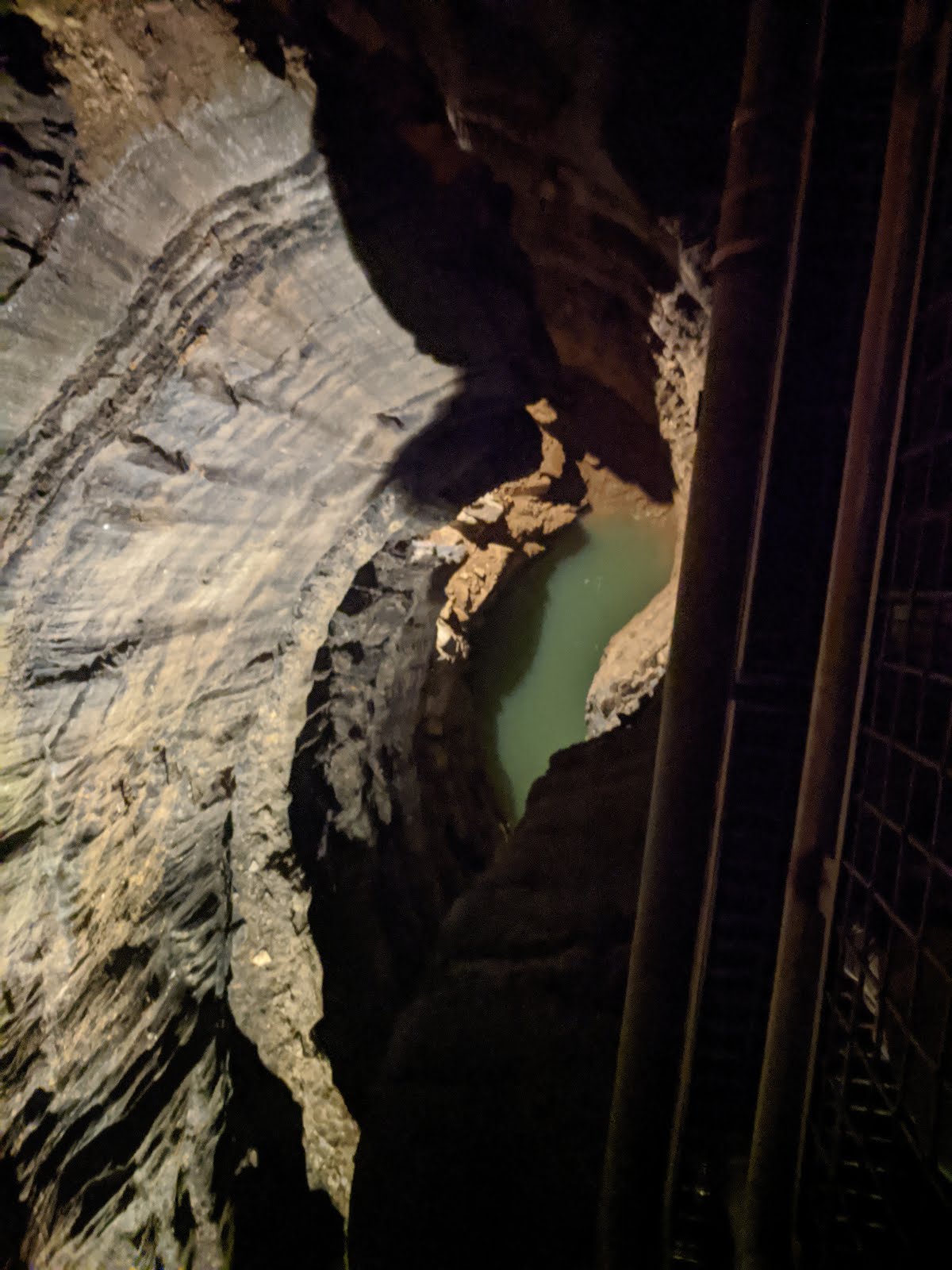
The first section was very tight, and very vertical. We went almost straight down very narrow cracks that made Kathleen very claustrophobic. This section is also still very wet and active, meaning the water is still actively eroding parts of the sandstone. It was incredibly beautiful but much tighter than anything we experienced on our first day's tour. It's hard for any of the pictures to do it justice, in part because we weren't taking pictures in the tightest bits.


The second part of the tour was similar to the cave sections we saw on the first day. It was mostly fairly open horizontal passages with large rooms. It was dry and dormant because the ground water level has receded considerably over the years.


The third part was probably the most spectacular and included the feature called the "Frozen Niagara." There are indeed other tours that go in and out the way we went out and focus completely on this section of cave. This section was wet and active again, in fact it was extra wet because the area had been experiencing a lot of rain.

Not the Frozen Niagra, just water flowing in

It also featured the classic cave formations that often come to mind. Frozen Niagara is a giant flow stone, "cascading" down the wall. From the Frozen Niagara you could take an optional addition 48 stairs down into the draperies room, which has these flow stones coming down all around you.

This is the Frozen Niagra

There were also lots of the classic stalagmites (pushing up from the ground with all their "mite") and stalactites (holding on "tite" to the ceiling). As well as places where they came together to create columns. All of these formations are made even more spectacular when you factor in that they grow about an inch in one hundred years...


Just like after the first tour we had to walk across mats soaked with soapy water in order to "cleanse our souls" and prevent the spread of white nose syndrome. Overall, even though this tour was a little tough on the claustrophobia, we thought it was more visually spectacular than the historic tour. It had more information about the formation of the cave, and was more scientifically based as well. However, with sufficient time, we would definitely recommend both. 


Wednesday, February 5, 2020

Mammoth Cave: Day 1


Mammoth Cave National Park was the 10th national park we visited. We knew absolutely nothing going into this park, so we started our trip at the visitor center. We weren't surprised to learn that we needed to pay for a tour in order to go into the cave itself. The most highly recommended tour was the historic tour. It started shortly after we got there, so we signed ourselves up and got going.

The historic tour enters the cave through the "historic entrance", a large, natural opening into the cave that has been used for cave tours for over 200 years. There were Native American artifacts found inside this entrance which dated back to 2,000 - 4,000 years ago. Not much is known about Native Americans in the cave except that they explored several miles of it and scraped gypsum off the walls.


Along the passage leading from the entrance to the first big open room, we noticed several weather stations that the national parks service uses to monitor conditions and airflow within the caves.


Along the path were old wooden water pipes, which followed us all the way to the "rotunda", the first large open room. There, an early 1800s saltpeter extraction process was preserved. Saltpeter, or potassium nitrate, was extracted by piling up bat guano (poop) into large boxes and running water over them. This pulled the potassium nitrate out of the guana and the water was sent back to the surface to be distilled for gunpowder, which was in high demand because of the war of 1812.


From there the tour went down and down through some tight spaces, passing over the "bottomless pit" and through "fat man's misery" and "tall man's agony". We fit without squeezing too much and didn't have to crawl, but the spaces were a bit too tight for Kathleen's liking.


The bottomless pit. Imagine it with no lighting
Kathleen squeezing through fat man's misery.
Kathleen fitting through some tight spaces

The last big cave feature of the tour was mammoth dome, a 192 foot tall, large opening underneath a sinkhole where water has been seeping in for millions of years. Here we saw a lot of dripstone on the walls and went up 60 stairs 


On our way back to the rotunda, we were fortunate enough to spot a bat on the ceiling! At the end of our tour, we had to walk over soapy, water-soaked mats to help prevent the spread of white-nose syndrome, a fungal infection responsible for the deaths of millions of bats in Kentucky alone.


So, what did we learn about the caves on our tour and during our stop at the visitor center thereafter? We learned that there are over 420 miles of connected cave and there are more areas still to be explored. The passageways and rooms were formed by water slowly eroding away the limestone as it seeped in, finding its way down and to the green river. Many of the features of mammoth caves are dry because of shale and sandstone found at the surface.

Cave tours into mammoth cave started over 200 years ago. Guides, usually slaves, would take people into the cave with nothing more than a few oil lanterns to light their way. Use of the caves, though, dates back to roughly 4,000 years ago with Native Americans. There are many names on the walls of mammoth caves that were burnt onto the rock using smoke. Only the ones predating the establishment of the park are legally there.


There are species that live nowhere else but in Kentucky caves, including the Kentucky cave shrimp and  colorless eyeless fish. The majority of the nutrient enter the cave through species that go in and out, including bats, cave crickets and small mammals. 

After several hours of touring the cave and exploring the visitor center, we decided to take Aiden on a hike around the park, above ground. On the hike we got to see the green river, which the water in the cave flows into, the sink hole that flows water into mammoth dome, and plenty of deer which were very unafraid of people.